

How to Fix Your Morning Scroll
Issue 05: ChatGPT's Growth / Infra Wars / Evil Hardware


Hello Futurists,
When you check your phone first thing in the morning, it’s not a bad habit. It’s a symptom of bad design.
Consumer hardware has been co-opted to hijack your behaviors and capitalize your attention.
But there is a solution.
Also… catch up on this week’s biggest AI headlines:
ChatGPT has 800 Million Weekly Users
Sora Hits #1 on the App Store
NVIDIA invests $2B into Elon Musk’s xAI
OpenAI Takes a 10% Stake in AMD
Is Tim Cook Getting Fired?
Sponsor: Surf — AI-powered crypto copilot that combines institution-grade research and onchain execution.

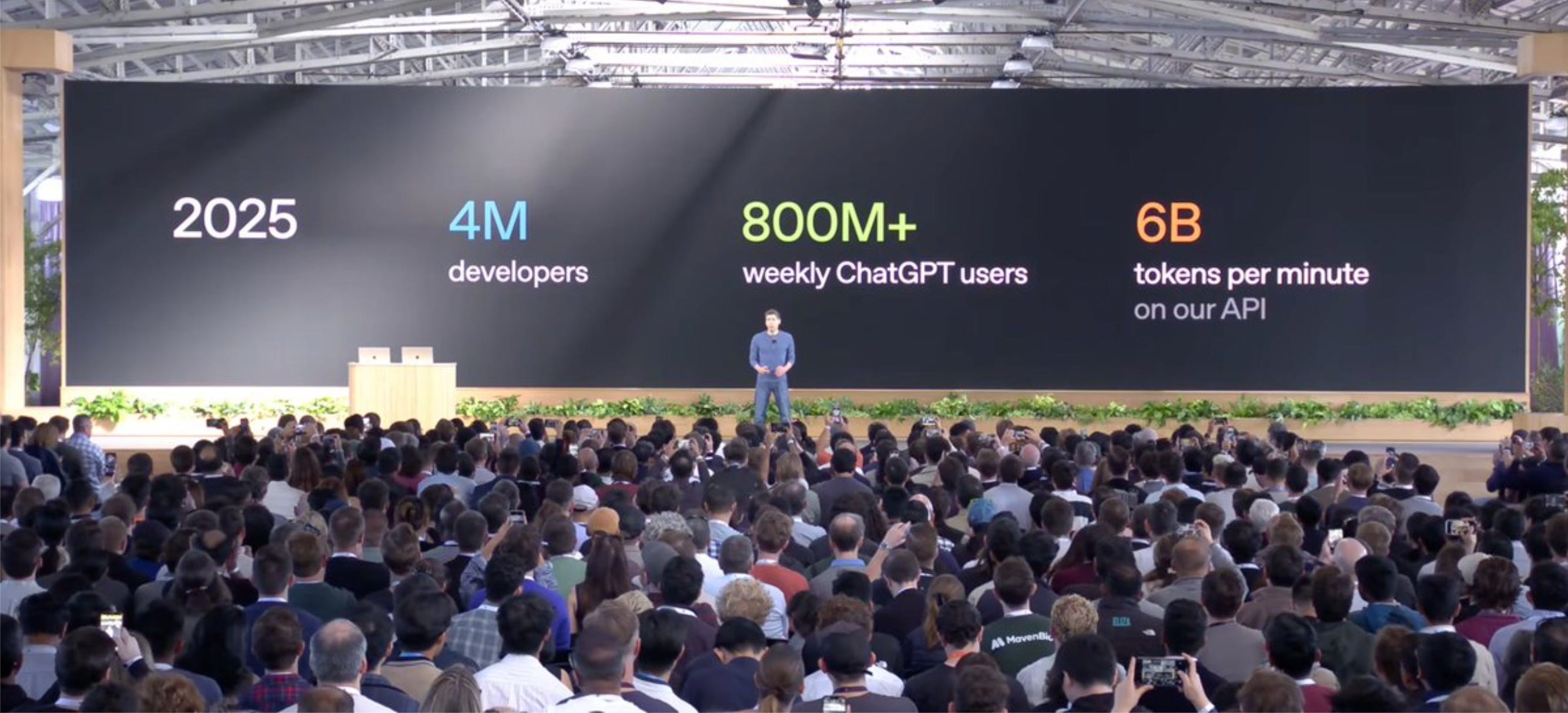
ChatGPT has 800 Million Weekly Users
That’s 1 in 10 people across the entire world btw. As we saw in their 2025 Dev Day, ChatGPT is indisputably becoming the most disruptive app we’ve seen since Facebook.
It’s also the fastest-growing, given they only broke 100M users in November 2023. That’s an 8x in two years.
And this growth has primarily come through a singular app: the flagship chatbot.
With 4 million developers hacking away on tools and integrations, the budding app ecosystem should bring that number even higher.
Sora Hits #1 on the App Store
OpenAI now holds the top 2 spots on Apple’s app store, with their new AI video social media app Sora taking the coveted #1 spot.
OpenAI has proven again they can build successful products on top of the frontier AI models. We’ve seen similar AI video models from Google and MidJourney, but neither have seen Sora 2’s instant popularity.
The demand for creator-friendly AI is insatiable. With ChatGPT overhauling the written word (you’ll see no em dashes here), Sora 2 is a bold attempt to rival the brainrot farms.
Check out our episode on whether Sora 2 can beat TikTok.
NVIDIA invests $2B into Elon Musk’s xAI
NVIDIA has reportedly invested $2 billion into an xAI equity and debt round via a special purpose vehicle (SPV).
The funding will give Elon priority access to NVIDIA chips for installation in their upcoming AI data center Colossus 2 in Memphis, TN.
This marks a strong partnership in a hypercompetitive race as AI labs work to secure maximal compute to train the next generation of models. The finish line is the fabled “AGI”, an intelligence superior to our own species.
After news broke, Jensen Huang went live on CNBC stating “the only regret I have is not giving him [Elon] more money”.
OpenAI Takes a 10% Stake in AMD
Jensen wasn’t the only one to make moves this week.
Lisa Su, CEO of AMD, announced an ambitious partnership with OpenAI to supply 6 gigawatts of compute over the next 5 years to scale Stargate, OpenAI’s data center empire.
The deal will see over 5 million units of AMD’s MI1450 GPU supplied to the AI giant. At $20,000 per GPU, thats $100B in top-line revenue and $50B gross profit for AMD.
AMD stock price jumped nearly 50% on the news, and the $50B market cap boost effectively makes this a “free deal.”
As a sweetener, AMD has offered OpenAI the right to purchase 160M shares of AMD (10% equity) at a discounted, set price.
With not enough cash on-hand nor chips available to currently act on this agreement, we’ll see how the deal works out over the next few years.
Is Tim Cook Getting Fired?
Rumors have circulated this week that Apple CEO Tim Cook will step down and be replaced with John Ternus, current VP of Hardware Engineering.
This comes in the same week as news that Apple might be retiring the Apple Vision Pro in favor of glasses, akin to Meta’s new Ray-Ban Displays they debuted last week.
Apple has been losing the AI race, and if they don’t do something about it now, they could die a slow death.
Personally, I’m excited for the change. While Cook was the right leader to succeed Steve Jobs at the time, Apple now needs someone with experience building hardware form-factors for the new age.
The Curious Case of Design Disgrace
Josh Kale laments the state of consumer hardware and offers the solution.
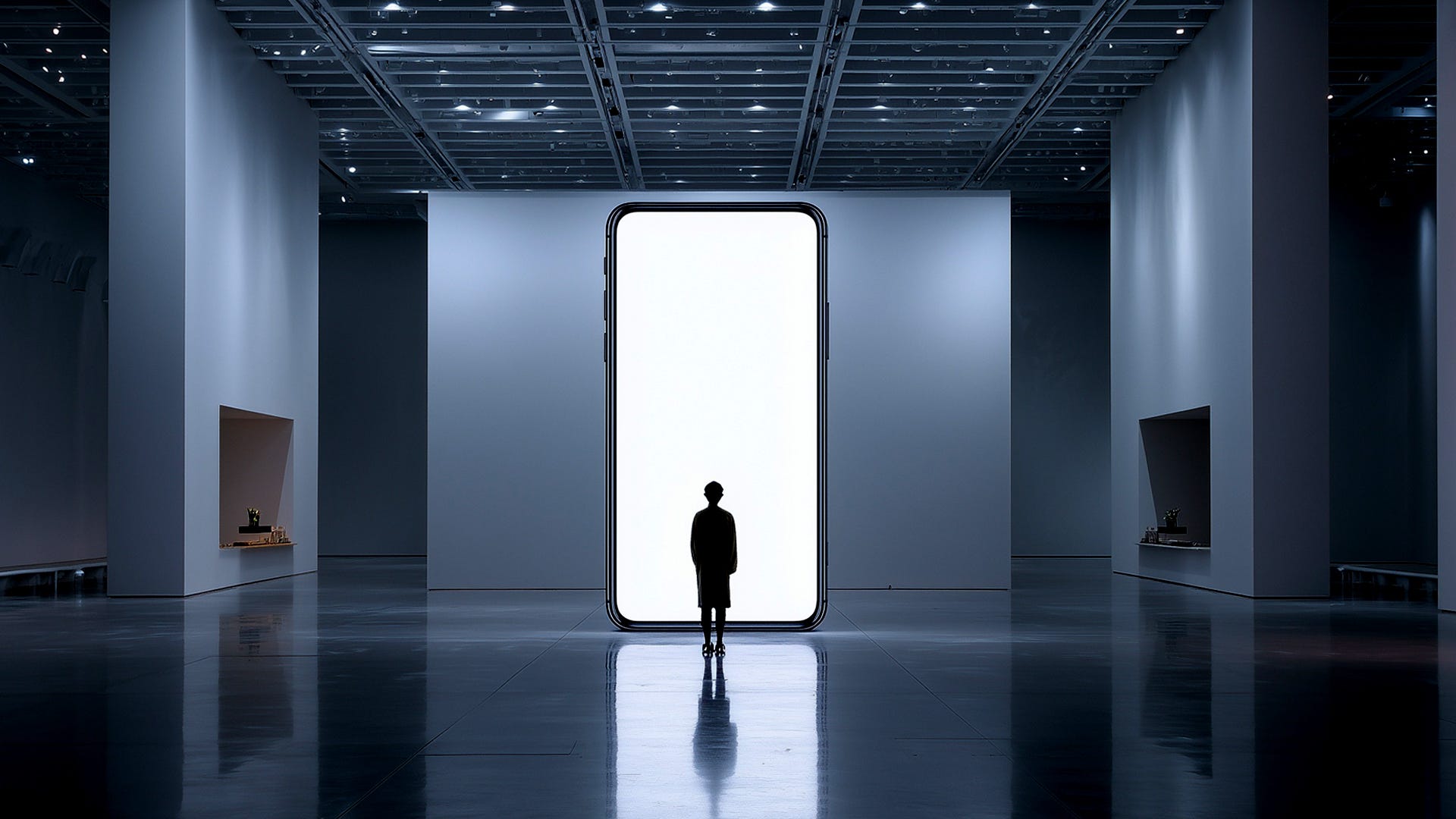
There’s a feeling when when you wake up and immediately pick up your phone… and it’s not joy.
It’s a low hum of anxiety, a reflexive tug to check one more thing. That isn’t an accident. Devices and apps have been optimized for casino-like rewards. We traded delight for compulsion, and now the default posture of technology is harvesting attention, not honoring it.
You can make almost anything addictive by turning it into a slot machine: pull-to-refresh, infinite scroll, mystery notifications. And app developers are only getting better at it: more persuasive UX and processed dopamine loops. It has become a question of public health, not just product tactics. That’s not what great tools should do to their owners.
Meanwhile, the form factor of personal computing has barely changed. We still carry a glass slab whose primary multi-touch interface was released in 2007, which we now ask to host this era of ambient, cutting edge, hyper-intelligent AI. It’s senseless, and attempts to replace the smartphone have merely copied and pasted new behavior onto old assumptions.
Rabbit’s R1 promised a simpler interface and shipped an undercooked Android app in an ugly plastic shell. Humane’s AI Pin promised freedom from screens and delivered heat, recalls, and total dysfunction. Even Meta’s glasses leave users juggling the tradeoffs of wearing a face camera in exchange for a mediocre display and exhausted use cases. The pattern is clear: slapping AI onto yesterday’s innovation doesn’t fix the problems.
There is, however, another path: one that starts with care. Jony Ive has spent a career arguing that care is the core of design, including the parts you don’t see. Care shows up in tolerances, in the way edges meet, in how a product behaves when it’s busy, or when you are.
It’s fitting that Ive’s studio is working with OpenAI on a new kind of device: a small, screenless object that aims to be a companion rather than a slot machine. The reports are early, the problems real, but the intent matters: to replace extractive habits with quiet capability.
When you start from care, different requirements fall out. A humane device should reduce cognitive spikes, not induce them. It should default to calm: passive notifications, soft haptics, voice that defers rather than dominates. It should practice reversibility: every action is safe to undo, every capture obvious and consented. It should bias toward subtraction: fewer surfaces, fewer modes, fewer chances to yank your attention sideways. These are not aesthetic luxuries; they’re the difference between a tool and a trap.
That’s why the operating system itself needs a rethink. Instead of apps as boxes and screens as the stage, imagine an intent-first OS that treats everything you do as a verb: “send this,” “remember that,” “explain what I’m looking at,” “hold my calls unless it’s my parents.” Sometimes the interface is a sentence; sometimes it’s a chime and a light.
Sometimes the best UI is no UI at all because the system already did the thing you meant, and quietly predicted what you’ll want next. AI is not a personality but a capability broker, routing your intent to the right tools with minimal interfacing. When toolmaking is done correctly, it feels impossible that things were ever done another way. The tool disappears, augmenting the experience without burden.
If recent AI gadgets taught us anything, it’s that new forms don’t excuse poor fundamentals. Battery, latency, and reliability are not marketing footnotes; they’re the entire product. That’s why the OpenAI <> Ive effort is fascinating. Jony and Steve defined the last great mobile era. 18 years later, the basic iPhone and iOS patterns still frame nearly every handset across every company. Not because we ran out of ideas, but because the original was good enough.
We’ve seen this in other categories. Without Elon and Franz proving that EV’s could be not only viable, but better, the industry likely doesn’t even exist at all. One team clearing the bar redefines what “normal” looks like and gives permission to others to enter the newly opened doorway.
The inverse is also true. Look at consumer VR: nine years of Oculus headsets with janky hardware and thin software, and still no canonical device. When no one clears the excellence bar, the field meanders indefinitely, totally lost.
Setting a precedent of excellence for the era of ambient AI is profoundly important. It’s the most consequential technology of our lifetime. The world needs a reference design that it can copy, and then improve.
Design disgrace ends when we choose care over capture. The measure isn’t how many swipes per minute we can elicit, but how we feel as we experience life with technology by our side: clearer, lighter, more ourselves. That’s the standard. When you build for that, the morning scroll will go extinct. The technology will just be there, everywhere, ready to serve and remarkably capable in how it does so.
That morning reach becomes a brief moment of peaceful bliss, all thanks to something made with care by a brilliant team who deeply seeks to improve the human experience. A team brave enough to wipe the slate clean, and try this whole technology thing all over again. ♦️
FRIEND & SPONSOR: SURF
Discover. Analyze. Execute. All in one place. Surf is the first crypto AI platform built for serious traders — combining institution-grade research with seamless onchain execution. From uncovering opportunities to putting together sourced back content, Surf delivers:
Comprehensive onchain data
Real-time social sentiment
Pro-grade technical analysis & insights
Stop wasting time juggling tools. Try Crypto AI that actually works.
👉 Sign up today and use code BANKLESS for a 7-day free trial!
Thanks for joining us for our fifth issue. Now, go listen to our podcast :)