

Flipping a Machinery Monopoly
Essay: A San Francisco startup is tapping particle accelerators to flip a machinery monopoly.

There is a machine in the Netherlands that makes the most expensive light on Earth.
It fires a laser at droplets of molten tin, fifty thousand times per second, vaporizing each one into a plasma 50 times hotter than the surface of the Sun. From that tiny supernova, a sliver of extreme ultraviolet light emerges, bounced off mirrors so smooth that if scaled to the size of Planet Earth, the imperfections would be the thickness of a playing card.
The machine draws 1.5 megawatts from the grid. That’s 1,500,000 watts of electricity. One watt of usable light reaches the wafer.
It’s a miracle of engineering.
And also a single point of failure for modern civilization.
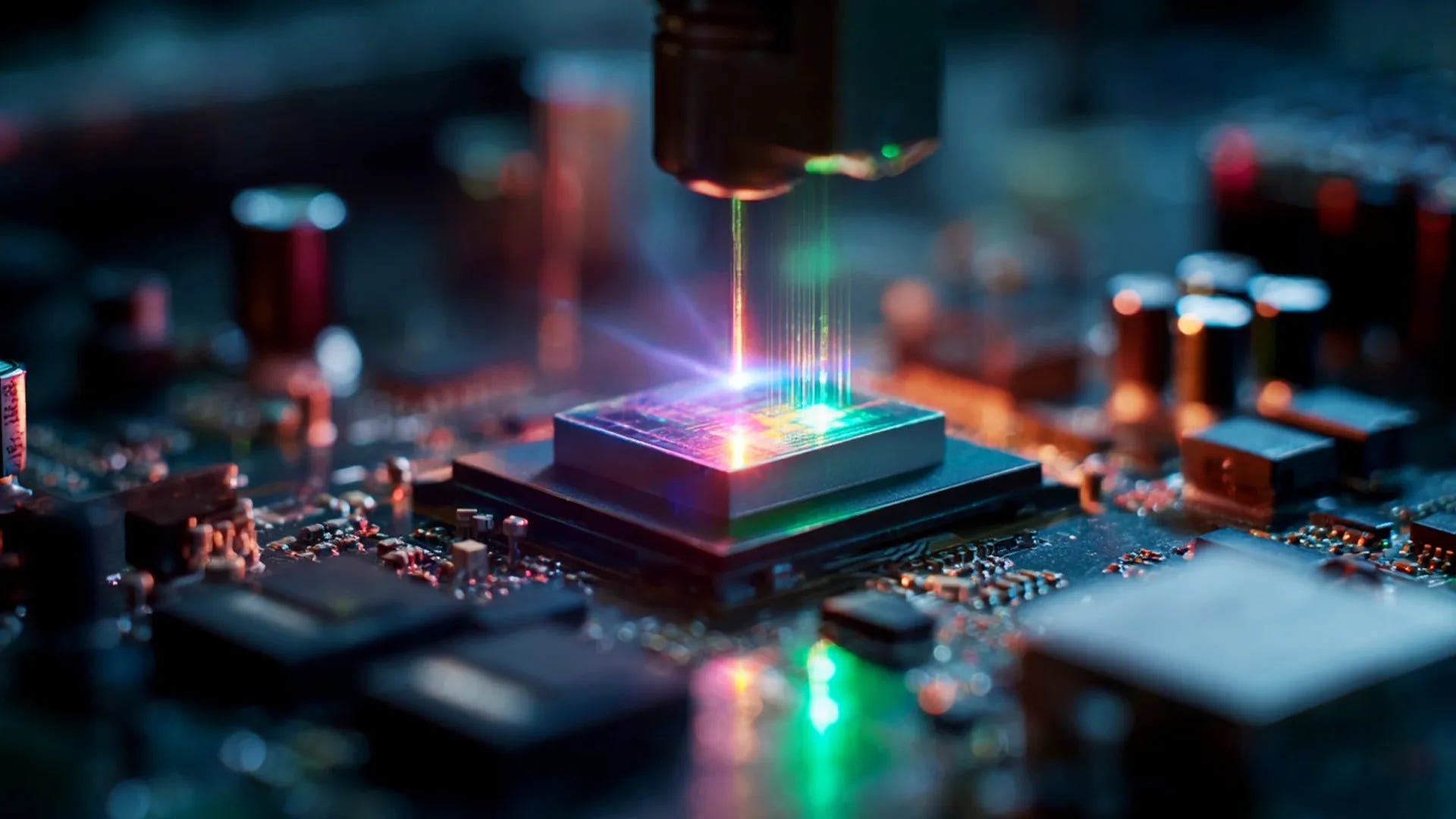
That machine is made by ASML. The sole manufacturer on Earth. One hundred percent market share. Every iPhone processor, every Nvidia GPU, every chip in every data center, all passed through one of their machines. Each costs upward of $200 million, with their newest models approaching $400 million. They ship fewer than fifty a year.
And once those machines print patterns onto silicon, fabrication happens almost entirely in Taiwan, at TSMC, which produces roughly 90% of the world’s most advanced logic chips. An island that China considers a breakaway province. A hundred miles off the coast.
The entire digital economy rests on this. It more closely resembles a prayer than a supply chain.
The painful irony is that the United States has invented almost every foundational semiconductor technology. Transistors. Integrated circuits. CMOS. EUV lithography itself was researched for decades at American labs. Then we handed it to a Dutch company to commercialize. Nine billion dollars in R&D later, ASML controls the most important chokepoint in technology. We invented the future and let someone else own it.
A company in San Francisco called Substrate is trying to change this.

You can think of ASML’s approach as a Rube Goldberg machine. Brilliant, but breathtakingly complex. Tin droplets, plasma, vacuum chambers, atomically smooth mirrors, over 100,000 parts from thousands of suppliers.
Substrate’s approach is fundamentally simpler. Instead of creating light through that elaborate chain of events, it uses a particle accelerator, a technology scientists have been building and refining for nearly a century, to generate X-rays directly.
X-rays have shorter wavelengths than the extreme ultraviolet light ASML uses. Shorter wavelengths mean you can print smaller, more precise patterns on a chip, like switching from a marker to a fine-tip pen. And because the underlying physics of particle accelerators are well understood, the core science isn’t a gamble.
What’s new is pointing that science at chipmaking.
Substrate has already demonstrated this at U.S. national labs, printing features at 12 nanometers, matching the resolution of ASML’s newest machines. But the number that matters most: they claim they can bring leading-edge wafer costs from $100,000 to below $10,000, using tools that cost a fraction of what ASML charges.
The plan goes further than just building a cheaper machine. Substrate isn’t selling tools to existing chipmakers the way ASML does. It’s building its own factories, controlling everything from the light source to the finished chip. When the tool and the factory are designed together from the ground up, you eliminate layers of complexity and cost that accumulate when bolting together equipment from dozens of different companies. It’s the same logic that gave Apple a performance edge when it started designing its own chips instead of buying off the shelf.
Can Substrate actually pull this off? Skeptics have history on their side. ASML took thirty years from lab to production. Substrate says 2028. They need to reinvent not only the tool but the entire surrounding ecosystem, from scratch.
But the remaining risk is engineering, not science. That distinction matters. Science risk means you might be wrong about how the universe works. Engineering risk means you need to build something very hard. Hard things get built.
Whether Substrate becomes proof of that is one of the most interesting questions in technology.
I’m rooting for them big time.
Thanks for joining us for our latest issue. Now go listen to our podcast :)